
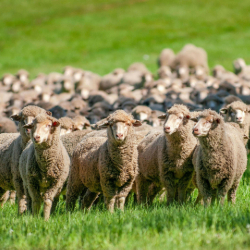
A Small Industry Tied to a Global Benchmark The U.S. wool industry is small by global standards but heavily export-dependent, with roughly 60 percent of U.S. wool leaving the country each year. Australia, by contrast, dominates world wool trade. Because the U.S. lacks a deep domestic auction market, USDA and industry groups look to Australia's AWEX Eastern Market Indicator (EMI) as the benchmark for global wool prices. USDA reports make the link explicit. Australian wool is quoted in U.S. dollars per pound delivered to Charleston, South Carolina, freight included, and roughly 75–85 percent of that landed price is used to estimate clean values at the U.S. warehouse and grower level. American wool is effectively priced as a discount to...


 What You Need to Know Today: New World screwworm detections in the United States continue to accelerate, with 81 new cases reported in November, bringing the cumulative total to 165. The first detection in a pig in Zapata County, Texas, highlights the potential implications for the U.S. pork i...
 A large market that competitors serve and that most U.S. producers have not looked at. Key Takeaways: Australia, Brazil, India and New Zealand built export businesses around Muslim-majority demand. The U.S. built markets differently. Halal is the gate: certification, government recognition and...
 A group of mid-sized beef packers sent a letter to Congress supporting the USDA’s voluntary Product of the USA label, which has been adopted by more than 30 companies. The voluntary label was introduced on 1 January 2026. It requires that single-ingredient beef products come from cattle b...

From WPI Consulting
Forecasting developments in production agriculture

On behalf of a private U.S. agricultural technology provider, WPI’s team generated an econometric model to forecast the movement of concentrated corn production north and west from the traditional U.S. Corn Belt. WPI’s model has subsequently provided quantitative support to a multi-million-dollar investment into short-season corn variety development. WPI’s methodology included a series of interviews with regional grain elevators and seed consultants. Emphasizing outreach and communication with stakeholders who possess intimate sectoral knowledge – on-the-ground insights – is a regular component of WPI’s methodologies, made possible by WPI’s ever-growing network of industry contacts.